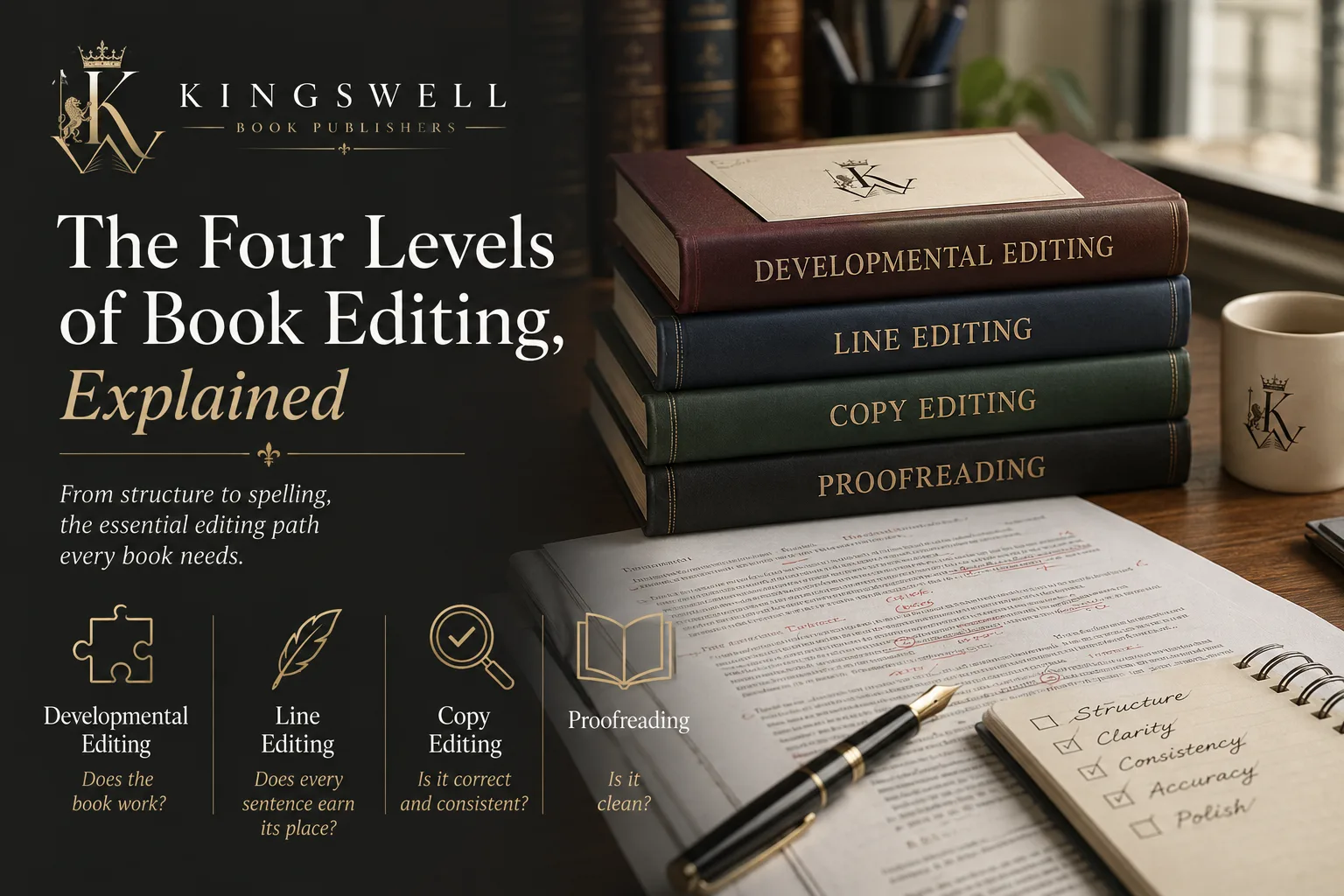
When an author tells us their book “just needs an edit”, the useful next question is always: which one? Editing is not a single service. It is four distinct jobs, done in a fixed order, by people using different parts of their attention. Confusing them is the most common reason manuscripts come back disappointing, and the most common reason quotes differ by a factor of five.
The Four Levels At A Glance
| Level | What it fixes | When it happens | What it will not do |
|---|---|---|---|
| Developmental / structural | Argument, plot, order, pacing, what is missing | First, on a complete draft | Polish sentences |
| Line editing | Rhythm, clarity, repetition, voice | After structural revisions are agreed | Reorder chapters |
| Copy editing | Grammar, consistency, house style, factual slips | Once the text is final | Rewrite for effect |
| Proofreading | Typos, spacing, bad breaks, layout errors | Last, on the typeset pages | Change the words |
The order matters more than most authors expect. Polishing sentences before the structure is settled means paying to perfect paragraphs that are about to be deleted.
1. Developmental Editing: Does The Book Work?
This is the pass that changes books. A developmental editor reads for the whole: whether the argument builds, whether the story earns its ending, whether chapter nine should be chapter three, and whether the thing the book is really about is actually on the page. The deliverable is usually an editorial report of several thousand words rather than a marked-up manuscript.
It is the most expensive level and the one most often skipped, which is unfortunate, because it is the only pass that can save a book that does not yet work. Non-fiction feels this most sharply: a business or memoir draft that is genuinely three books sharing a folder cannot be rescued at the sentence level.
A structural edit is the only pass that can tell you the book is not ready. Every level below it assumes the book already works and makes it read better.
2. Line Editing: Does Every Sentence Earn Its Place?
A line editor works through the prose paragraph by paragraph, cutting the sentence that repeats the previous one, breaking the clause that has run away, and fixing the rhythm of a passage that has gone flat. This is where voice is sharpened rather than sanded off, and it is the level where the difference between a competent editor and a good one is most visible.
Fiction gains the most here. So does memoir, and any non-fiction that depends on being a pleasure to read rather than merely accurate.
3. Copy Editing: Is It Correct And Consistent?
The copy edit is the accuracy pass: grammar and punctuation, spelling consistency, hyphenation, capitalisation, and adherence to a style sheet. It also catches the errors that quietly destroy credibility: a character whose eyes change colour, a date that contradicts itself, a statistic that does not match its source, a chapter cross-reference pointing at the wrong chapter.
A proper copy edit produces a style sheet as a by-product: the record of every decision made about your book, which is what keeps a series consistent three titles later.
4. Proofreading: Is It Clean?
Proofreading happens last, on the typeset pages rather than the manuscript, because half of what it catches only exists once the book is laid out: a heading stranded at the foot of a page, a word broken badly across a line, a running head with the wrong chapter title. Proofreading a Word file and then typesetting it misses all of that, which is why we run the proof after formatting and typesetting, not before.
How Many Passes Does Your Draft Need?
| State of your draft | Passes usually needed | What to expect |
|---|---|---|
| First complete draft, never professionally read | All four | Substantial revision between passes; four to six months |
| Redrafted after beta readers, structure sound | Line, copy, proof | Prose-level work only; six to ten weeks |
| Previously edited, revised since | Copy, proof | Consistency and cleanliness; three to five weeks |
| Professionally edited, unchanged | Proof | Final check on the typeset pages; days |
If you genuinely do not know which row you are in, that is what an editorial assessment is for: a professional read that tells you what the manuscript needs before you commit to paying for it. It is the first thing our editing team does with a new manuscript.
Editing Is Not Ghostwriting
Editing improves what exists. If the draft is half-finished, or exists as notes, interviews and good intentions, no level of editing will close that gap. That is ghostwriting, a different service with a different process, in which the book still belongs entirely to you.
What It Costs, And Why Quotes Differ
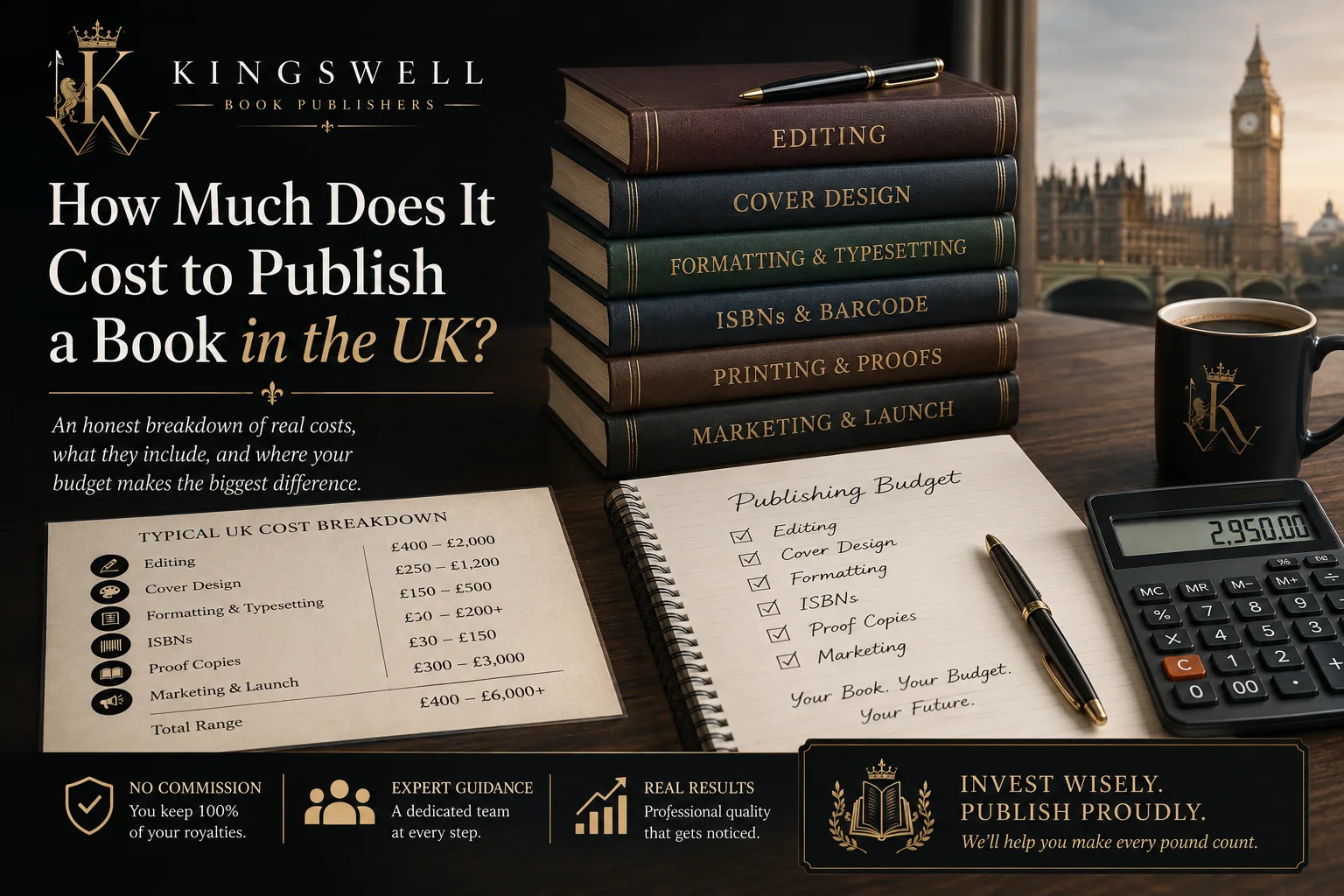
A proofread of a clean manuscript is a few days of work. A structural edit of a draft that needs reordering is several weeks. That is the whole explanation for quotes ranging from a few hundred pounds to a few thousand, and it is why any quote should state which level it covers and how many passes are included. The full picture sits in how much it costs to publish a book in the UK, alongside the other components of a publishing budget.
Where Editing Sits In The Whole Process
Editing comes after the draft and before everything else: design, registration, distribution and launch all assume a final text. You can see the full running order in how to publish a book in the UK, and once your text is final, the practical next step is getting your ISBNs, because the page count that editing settles is what your cover and your print specification depend on.
Frequently Asked Questions
What is the difference between line editing and copy editing?
A line edit works on how the prose reads: rhythm, repetition, clarity and voice. A copy edit works on whether it is correct and consistent: grammar, spelling, house style, timelines and factual slips.
One is about effect, the other about accuracy. Good editors do them as separate passes because the mindsets are different.
Can I skip the developmental edit if my beta readers liked it?
Sometimes, and it is worth asking honestly. Beta readers are excellent at telling you where they lost interest and unreliable at telling you why. If several readers stalled in the same chapter, or nobody can summarise your book in a sentence, the draft has a structural problem no amount of polishing will fix.
How long does each editing pass take?
For a typical 80,000-word manuscript: a developmental edit takes three to four weeks plus your revision time, a line edit two to three weeks, a copy edit one to two weeks and a proofread a few days. Author revisions between passes are usually the longest part of the calendar.
Do I need all four levels?
Very few manuscripts do. Nearly every manuscript needs a copy edit and a proofread. Whether it needs the two levels above them depends on the state of the draft, which is what an editorial assessment is for.
Will an editor change my voice?
A good one protects it. The purpose of a line edit is to make your voice more consistently itself, not to make it sound like the editor. If edited pages come back sounding like somebody else wrote them, that is a bad match rather than the price of editing.