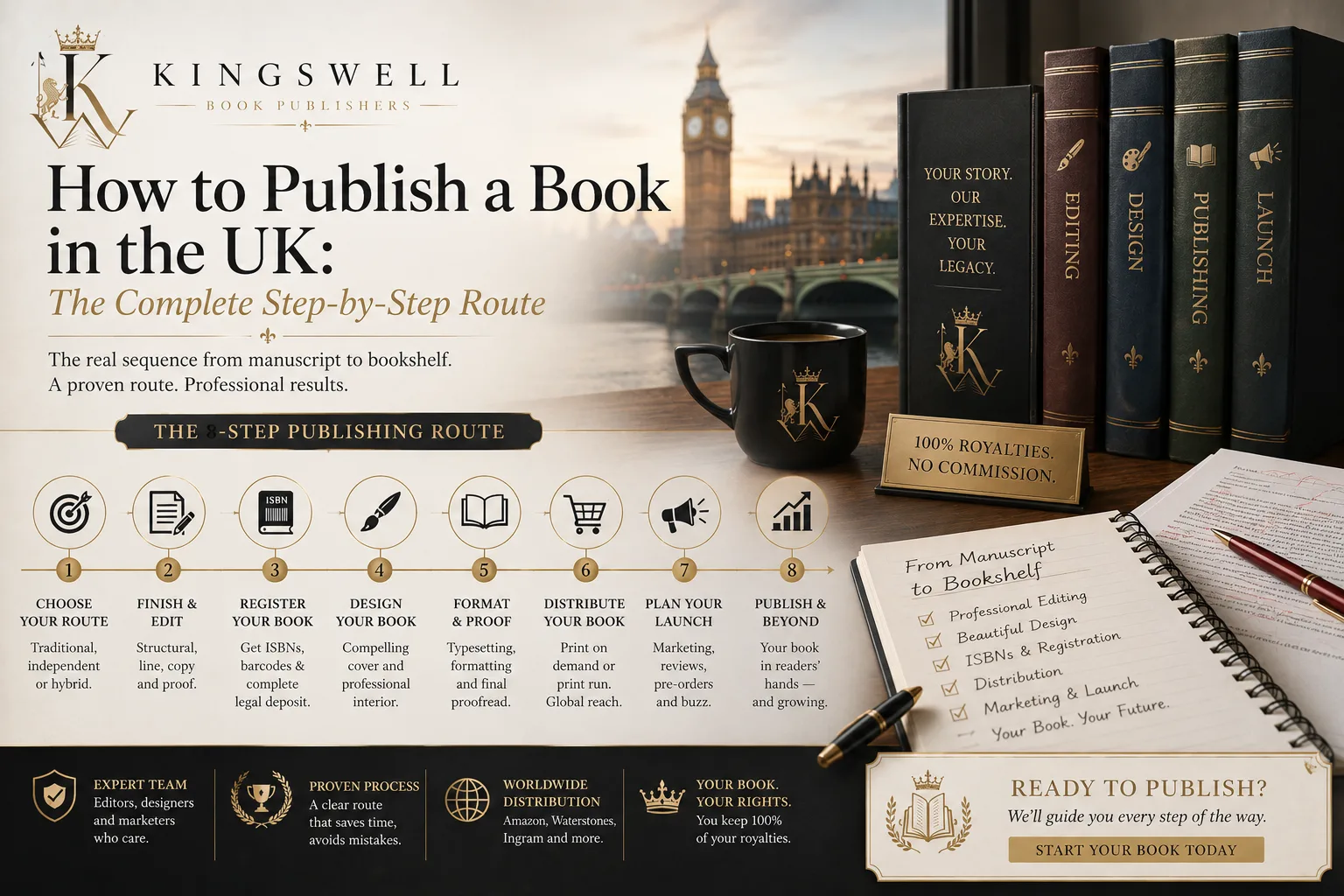
Every published book starts the same way: a manuscript, an author, and a decision about what happens next. What follows is the route we walk with authors every week: the real sequence, the real timings, and the parts that most first-time authors are surprised by.
Decide What "Published" Means To You
Before anything else, be honest about the outcome you want. The three routes below are all legitimate, and they demand very different things from you.
| Route | Who controls it | Typical time to shelf | Royalties |
|---|---|---|---|
| Traditional publishing | The publisher | 18–36 months after signing | Roughly 8–15% |
| Independent publishing | You | 4–8 months | You keep 100% |
| Hybrid support | Shared | 5–9 months | You keep 100% |
Traditional publishing is not a higher tier of the same thing. It is a different business arrangement, in which you exchange control and royalties for a publisher's distribution and advance. Neither is better. They are answers to different questions.
The authors who are happiest a year after launch are the ones who chose a route deliberately, rather than defaulting into it because a rejection letter arrived.
Get The Manuscript Genuinely Finished
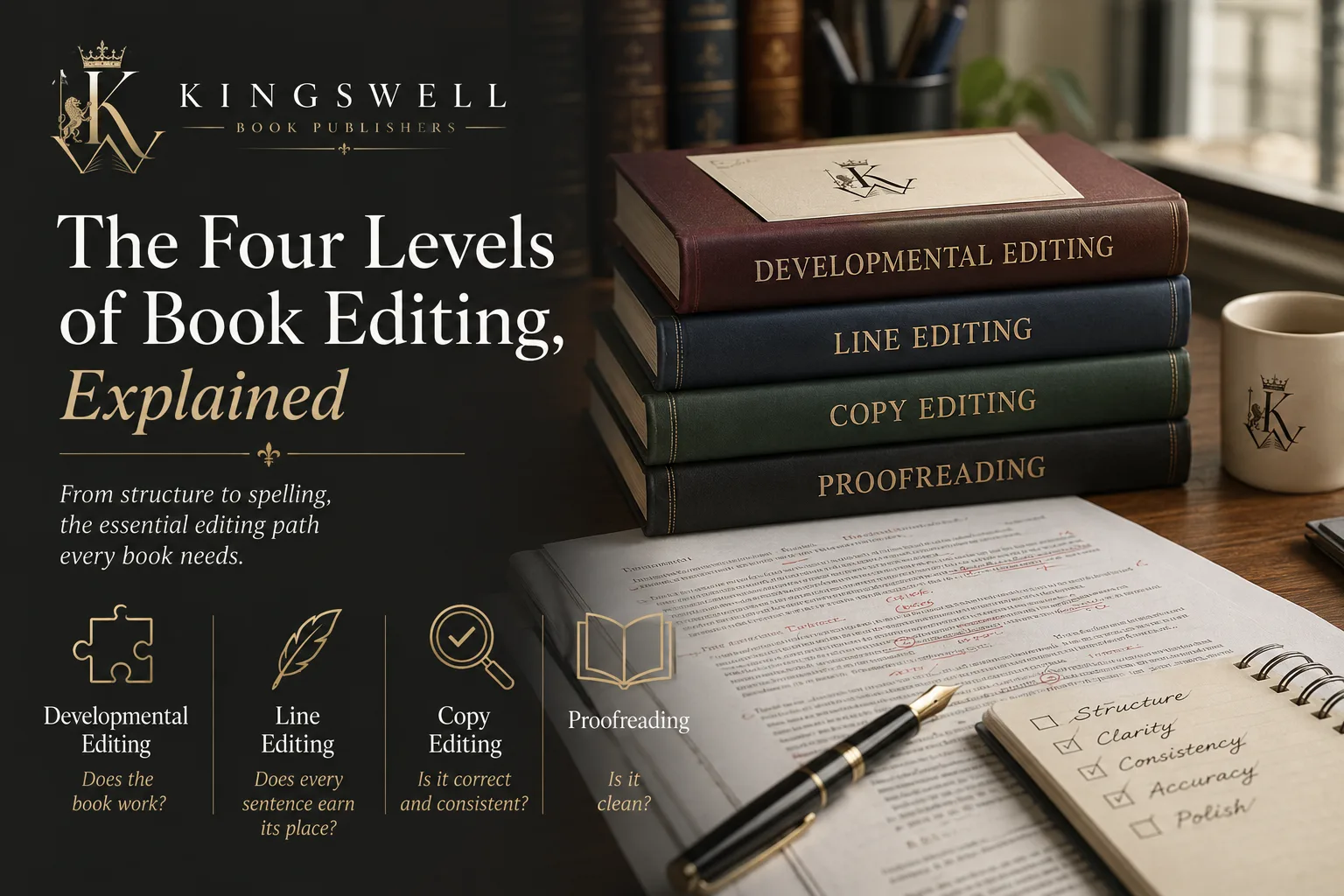
"Finished" does not mean you have stopped typing. It means the book does what you set out to make it do. Before it goes anywhere near a designer, a manuscript needs to survive three separate passes.
- Structural. Does the argument or the story hold? Is anything in the wrong order? This is the pass that changes books.
- Line. Does each sentence earn its place? This is where voice is sharpened rather than sanded off.
- Proof. Is it clean? Typos in a paid book cost you reviews.
These are genuinely different jobs, and running them together is why so many self-edited manuscripts read as almost-right. Our book editing service separates them deliberately, and the four levels of book editing explains how to tell which passes your own draft needs.
Registration: ISBNs And Legal Deposit
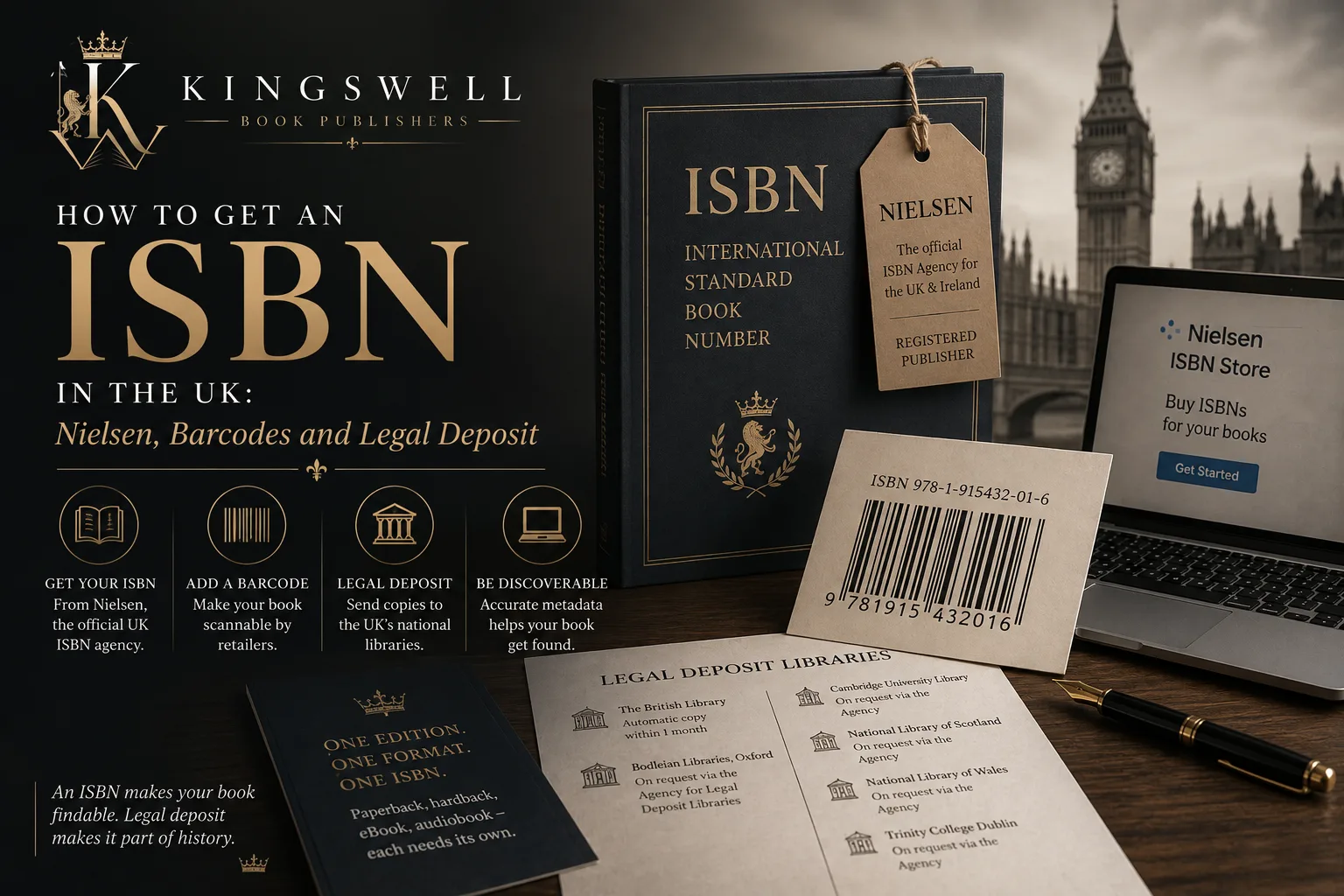
In the United Kingdom, ISBNs are issued by Nielsen. A few points that catch authors out:
- Each format needs its own ISBN. Paperback, hardback and eBook are three numbers, not one.
- Whoever owns the ISBN is recorded as the publisher of record. If you want that to be you, buy your own block.
- UK legal deposit requires you to send a copy to the British Library within one month of publication, and to five other libraries on request.
None of this is difficult, but all of it is easier to do before printing than after. Our full guide to getting an ISBN in the UK covers blocks, barcodes, metadata and legal deposit in detail.
Design Is Not Decoration
A cover has one job: to make the right reader stop. That means it has to look like it belongs in its genre while still standing out within it, which is why genre research matters more than personal taste. The interior matters just as much: margins, running heads and typographic hierarchy are what make a book feel professionally made rather than merely printed.
See how we approach both in cover design and proofreading and formatting.
Distribution: Print On Demand Or A Print Run
Print on demand carries no inventory risk and reaches Amazon, Waterstones online and worldwide retailers. A traditional print run costs less per copy but ties up capital and requires somewhere to keep the boxes. For a debut, print on demand is almost always the right first move, because you can always add a run later once you know what actually sells.
Launch Starts Before Publication Day
The single most common mistake is treating the launch as something that begins when the book goes live. By then the work should already be done: advance readers lined up, retailer metadata written, a pre-order page live, and reviewers approached. A book that appears on Amazon with no reviews and no audience does not fail because it is bad. It fails because nobody was waiting for it.
Our book marketing team starts this work roughly eight weeks before the publication date.
A Realistic Timeline
For a typical 70,000–90,000 word manuscript arriving in reasonable shape:
- Weeks 1–6: structural edit and author revisions
- Weeks 7–9: line edit and copy edit
- Weeks 8–12: cover design, running in parallel
- Weeks 12–15: interior formatting and proofread
- Weeks 14–18: ISBN, metadata, retailer setup, pre-orders open
- Weeks 18–24: launch campaign and publication
Six months is a realistic, unhurried schedule. It can be compressed, but every week you remove comes out of the editing, and editing is the part readers notice.
Where To Start
If your manuscript is finished, the next step is an honest read by someone who edits for a living. If it is not, the next step is finishing it, and if that is where you are stuck, a ghostwriter can carry the draft while the book stays yours.
Either way, the route is the same from there: edit, design, register, distribute, launch. Done in that order, with time given to each, publishing a book in the UK is a process rather than a gamble.
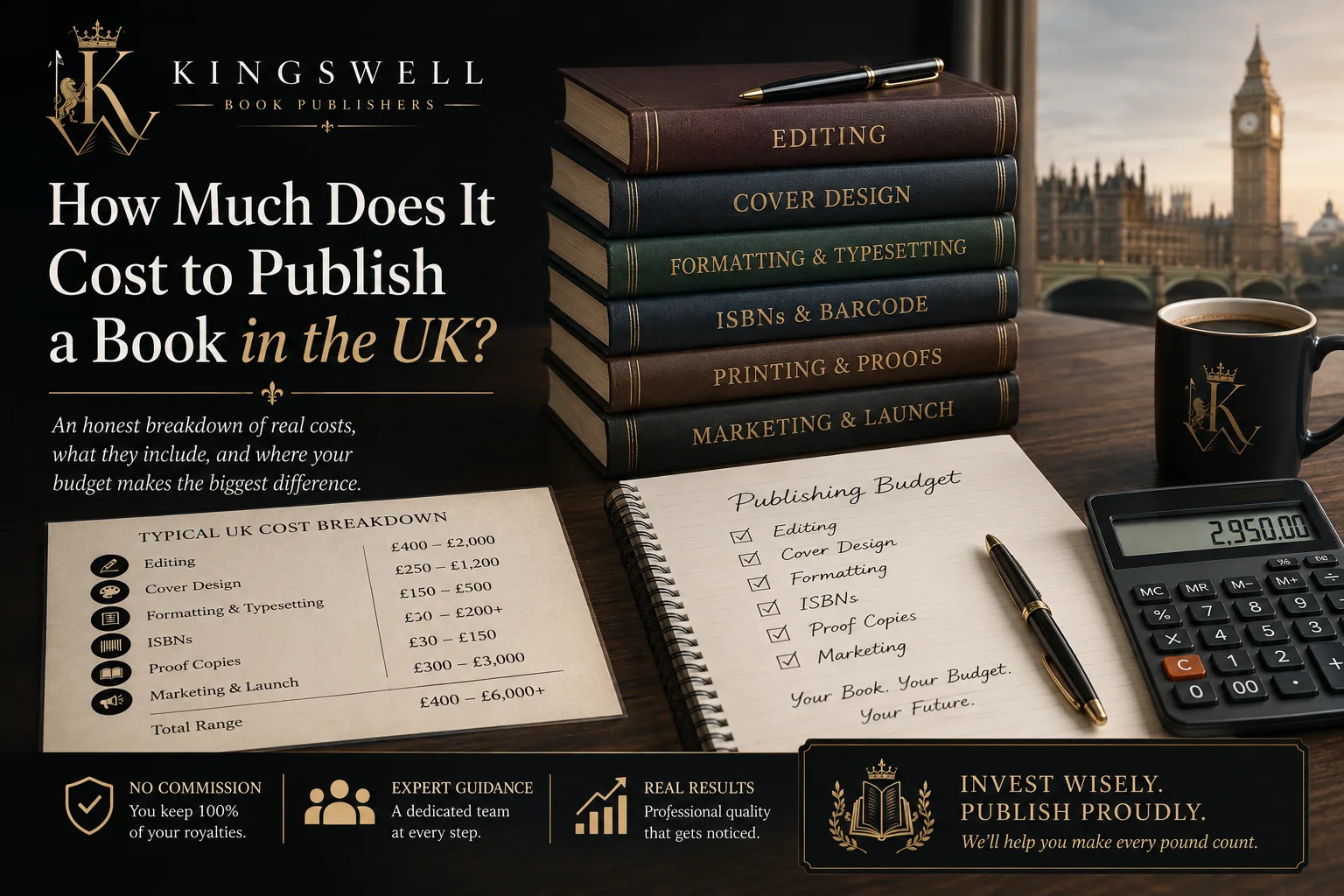
And if the next question is what all of that costs, the whole budget is broken down in how much it costs to publish a book in the UK.
Frequently Asked Questions
How much does it cost to publish a book in the UK?
It depends almost entirely on how much editing the manuscript needs. A clean draft that needs a copy edit, a cover and formatting sits at the lower end; a draft needing structural work costs more because that work takes weeks of an editor's time. See our pricing page for current packages.
Do I need an ISBN to publish a book in the UK?
You need one for each format you sell through retailers: paperback, hardback and eBook are three separate ISBNs. In the UK they are issued by Nielsen. Whoever owns the ISBN is listed as the publisher of record, so buy your own block if you want that to be you.
How long does it take to publish a book?
Around six months for a typical 70,000–90,000 word manuscript arriving in reasonable shape. It can be compressed, but the time usually comes out of editing, which is the part readers notice.
Will I keep the rights to my book?
Yes. Working with us you retain full copyright and 100% of your royalties. That is the central difference from a traditional publishing contract, where you assign rights in exchange for an advance and distribution.