It is the first question almost every author asks us, and the honest answer is a range rather than a number. Most UK authors spend between a few hundred pounds and about six thousand, and the difference is almost entirely down to how much editing the manuscript needs and how wide a launch the book gets. This guide breaks that range into its parts, so you can see where the money goes, and where it genuinely changes the finished book.
What You Are Actually Paying For
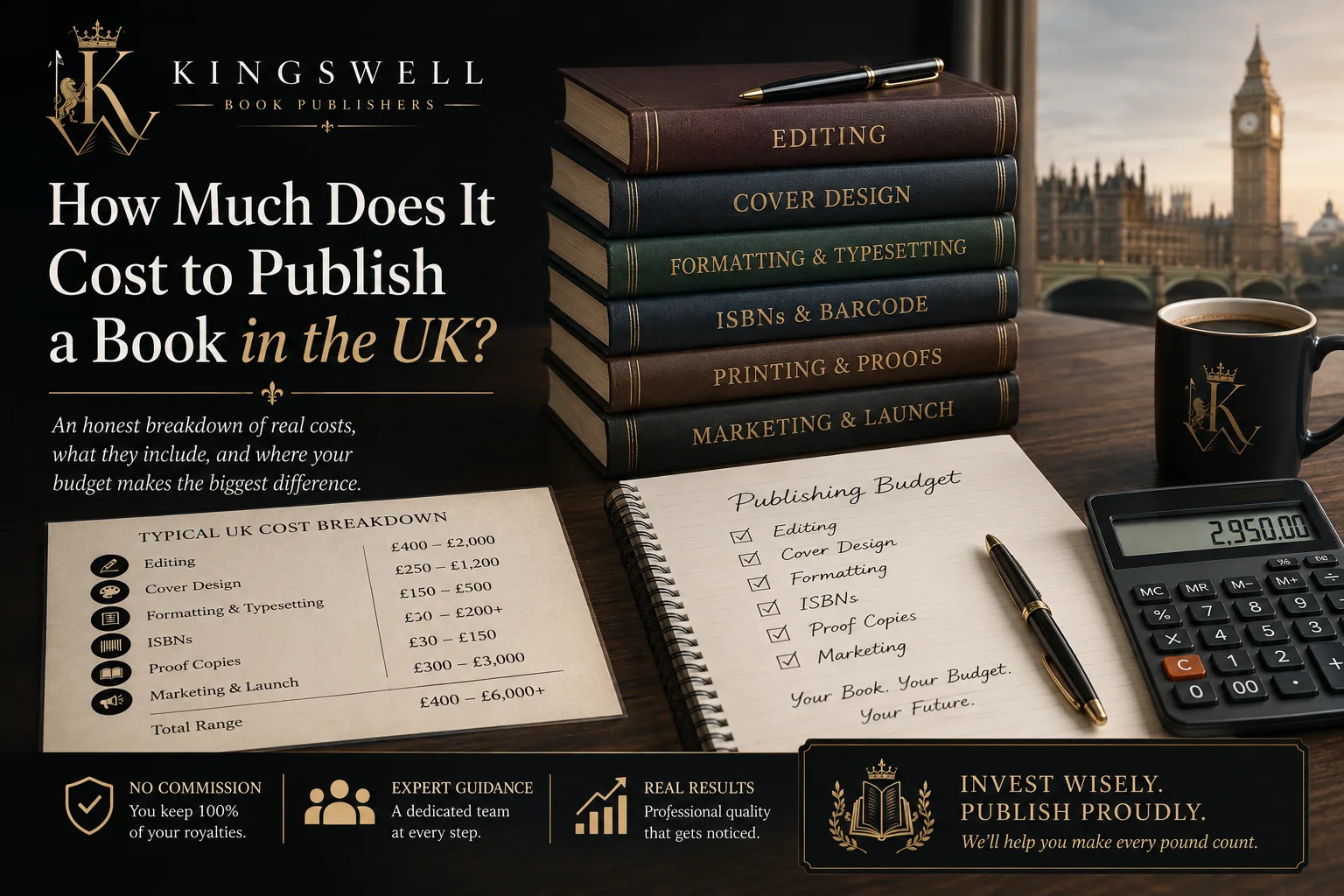
Publishing a book is not one purchase. It is eight or nine separate pieces of work, each with its own market rate. The table below shows typical UK ranges for a standard 80,000-word manuscript.
| Component | Typical UK range | What moves the price |
|---|---|---|
| Structural / developmental edit | £700 – £2,000 | How much rework the draft needs |
| Line and copy edit | £400 – £1,200 | Word count and error density |
| Proofread | £250 – £700 | Whether a copy edit came first |
| Cover design | £250 – £1,200 | Original artwork or licensed imagery |
| Interior formatting and typesetting | £150 – £500 | Images, tables, footnotes, index |
| ISBNs | £0 – £200+ | Free retailer number or your own Nielsen block |
| Proof copies and author copies | £30 – £150 | Format, page count and quantity |
| Audiobook production | £1,200 – £4,000 | Narrator, running time and studio |
| Launch marketing | £300 – £3,000 | Scope, ad spend and campaign length |
Two lines in that table deserve most of your attention. Editing is where a readable manuscript becomes a publishable book, and the cover decides whether anyone opens it. The rest is competent execution: necessary, but not where a book is won.
The Costs Authors Forget
The quoted figure is rarely the final figure, because these items sit outside most people’s mental budget:
- One ISBN per format. Paperback, hardback and eBook are three separate numbers, not one.
- Three cover files, not one. A paperback wrap, a hardback case and a flat eBook thumbnail are different artwork, sized differently.
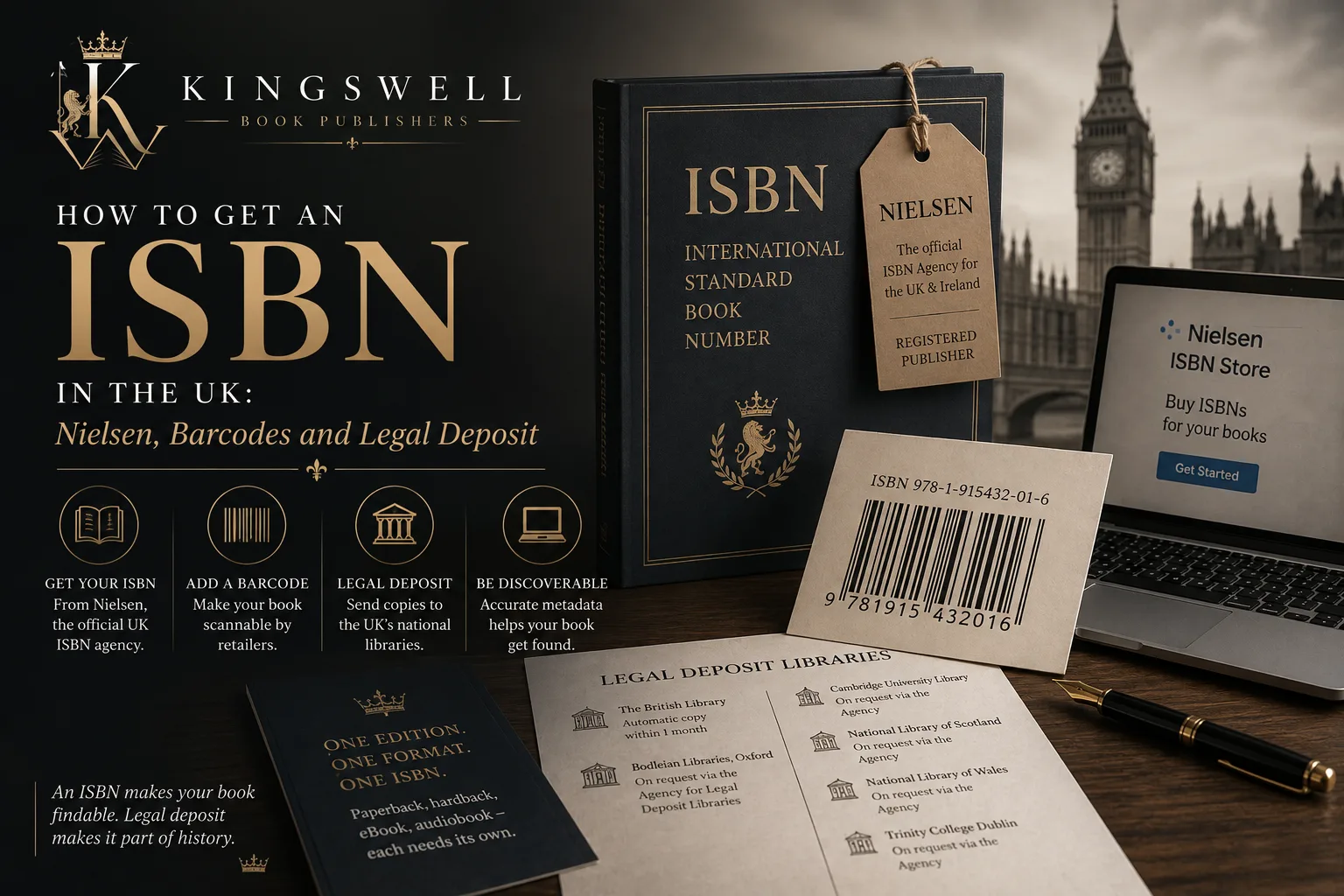
- Legal deposit copies. Six UK and Irish libraries are entitled to a copy, and the postage is yours.
- Re-uploads. Typos found after publication mean a corrected interior, a fresh proof and, at some retailers, a fee.
- Your own time. Revisions after a structural edit routinely take four to eight weeks of an author’s evenings.
Almost nobody regrets paying for the edit. Nearly everyone who skipped it pays for it later, after the reviews have already landed.
Buying Piece By Piece, Or Buying A Package
Hiring each freelancer yourself is usually cheaper line by line, and it works well if you are happy running the project: briefing the editor, matching the designer’s file to the printer’s specification, and fixing whatever the retailer rejects at eleven at night. A package costs more because it absorbs that coordination, and because the parts are built to fit together from the start.
Our own publishing plans are priced for the whole project rather than as a monthly retainer:
| Plan | Price | Best for | Formats |
|---|---|---|---|
| Essential | £399 | A clean draft needing proofreading, typesetting and a proper Amazon listing | eBook, paperback |
| Classic | £999 | Authors who want a custom jacket and distribution beyond Amazon | eBook, paperback, hardback |
| Signature | £2,199 | A full manuscript edit and a launch with a trailer behind it | eBook, paperback, hardback |
| Masterpiece | £5,999 | The complete launch, with audiobook and author storefront included | eBook, paperback, hardback, audiobook |
Every plan includes proofreading, professional formatting, a named project manager and 100% of your royalties, and we take no commission on any sale, ever.
Three Realistic Budgets
To make the ranges concrete, here is how three genuine author budgets tend to break down.
- The lean debut (£400 – £900). A manuscript already workshopped or beta-read, needing a proofread, a solid cover, clean typesetting and a competent listing. The money goes to presentation rather than rewriting.
- The standard route (£1,000 – £2,500). A first draft that has never been read professionally. Editing dominates the budget, with a custom cover, wide distribution and an eight-week launch plan.
- The full launch (£3,000 – £6,000). Edit, four formats including audio, a website or storefront, print copies for events, and a campaign running before and after publication day.
Where The Money Genuinely Changes The Book
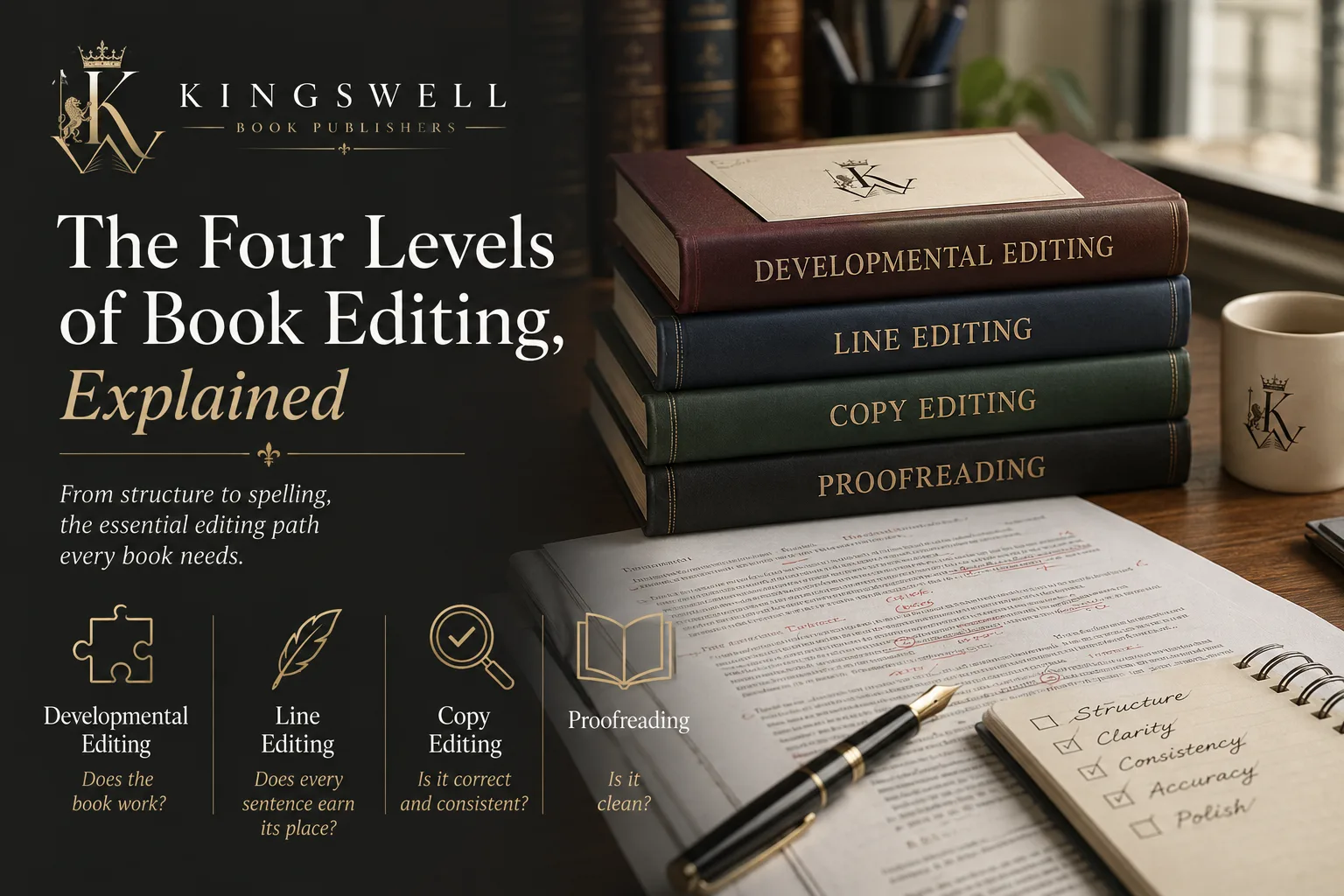
Spend on the edit first. A structural read tells you whether the book works, and no amount of design rescues one that does not. Our book editing service separates the passes deliberately, so you pay only for the ones your draft needs, and the four levels, with how to tell which you are looking at, are set out in our guide to the four levels of book editing.
Spend second on the cover. It is the only part of your book most potential readers will ever see, and genre fit matters far more than personal taste. Third, spend on interior formatting, because a badly typeset page reads as amateur before a single sentence has been judged.
Only then think about marketing, and start it roughly eight weeks before publication, not on the day.
What To Do Next
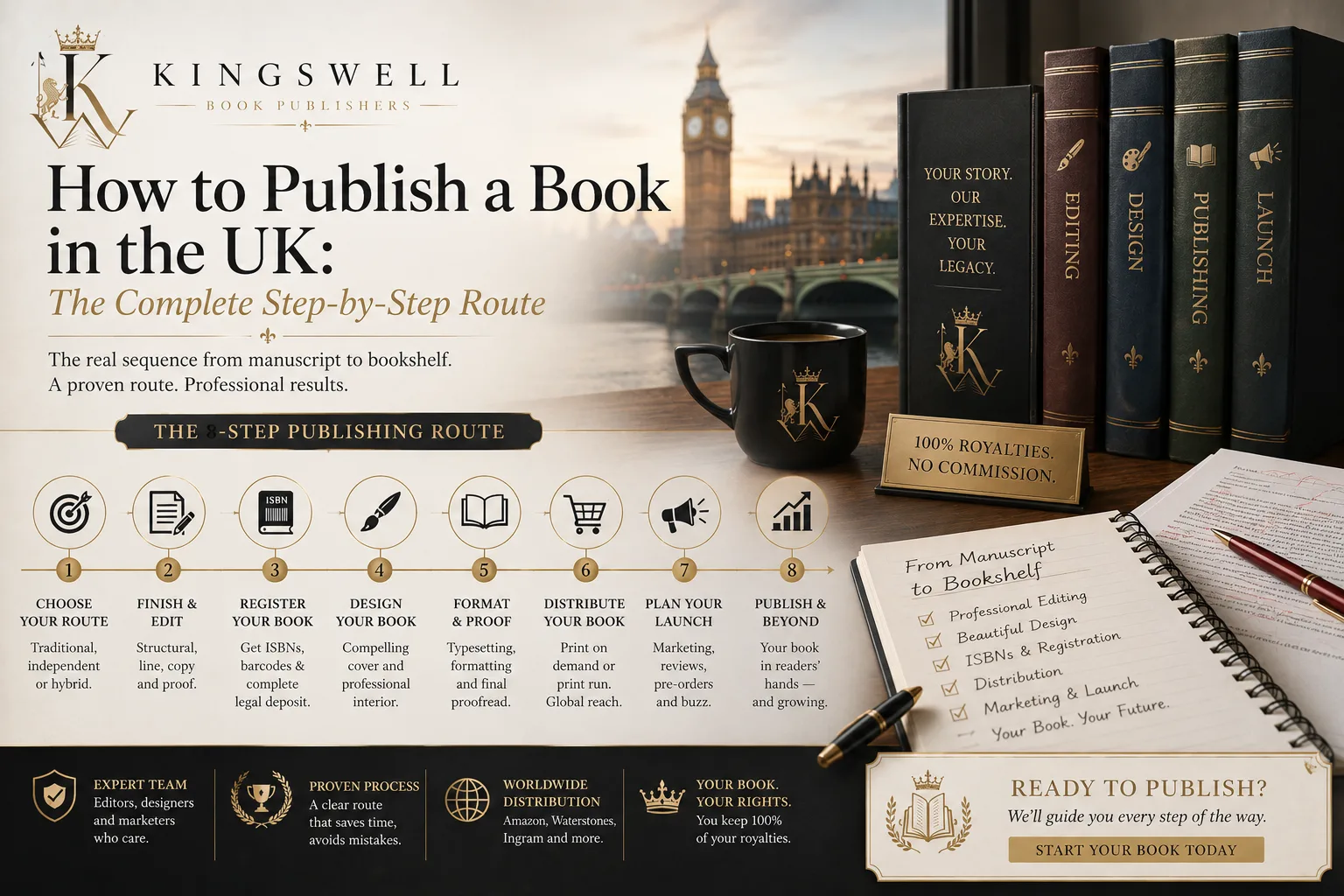
If you know what your manuscript needs, price the pieces against the ranges above and check them against our plans. If you do not, that is the normal position for a first-time author, and the whole sequence is set out in how to publish a book in the UK. Before you budget for distribution, it is worth understanding how ISBNs work in the UK, because that one decision determines whose name appears as the publisher of your book.
Frequently Asked Questions
Is it cheaper to self-publish or to use a publishing service?
Buying each piece yourself is usually cheaper on paper and more expensive in practice, because you become the project manager: briefing the editor, chasing the designer, and fixing the file the printer rejects. A package costs more up front and absorbs those hours.
The right answer depends on whether your time or your budget is the scarcer resource.
Do I have to pay for an ISBN in the UK?
No. Amazon KDP and most retailers will assign you a free identifier. The catch is that the retailer is then listed as the publisher of record, and the number is not portable to other shops.
Buying your own block from Nielsen keeps your own imprint on the record.
Why do editing quotes vary so much?
Because "editing" describes four different jobs. A proofread of a clean 80,000-word manuscript is a few days of work; a structural edit of a draft that needs reordering is several weeks. Always ask a quote which level it covers and how many passes are included.
Are there ongoing costs after publication?
Print on demand carries no storage or stock cost, so the recurring costs are optional ones: advertising, a website, and any corrected files you upload later. Some retailers charge a small fee to reissue interior files, which is one more reason to proofread before you publish rather than after.
Does a bigger budget sell more books?
Only where it buys editing, a cover that fits its genre, and a launch that starts before publication day. Money spent on those three moves the numbers. Money spent on advertising a book that has had none of them rarely does.